---
title: "Emulation: Reduce Project Risk and Increase Certainty in Outcome"
description: Test PLC code, validate controls, and run production scenarios before startup to ensure a smoother launch using emulation.
image: https://info.polytron.com/hubfs/Blog/Feature%20Images/Emulation%20Blog.png
---
[Polytron Named Top Work Place Learn More](https://info.polytron.com/blog/polytron-receives-back-to-back-top-workplace-honors)
[](https://polytron.com)
- [Services](https://polytron.com/services/)
Close Services Open Services
- [Industries](https://polytron.com/industries/)
Close Industries Open Industries
- [Resources](https://polytron.com/resources/)
Close Resources Open Resources
- [About Us](https://polytron.com/about-us/)
Close About Us Open About Us
[Packaging](https://polytron.com/services/packaging/)
[Process Control](https://polytron.com/services/process-control/)
[Industrial Network and Security](https://polytron.com/services/industrial-network-and-security/)
[Automation and Controls](https://polytron.com/services/automation-and-controls/)
[Machine Safety](https://polytron.com/services/machine-safety/)
[Capital Projects](https://polytron.com/services/capital-projects/)
[Predictive Maintenance](https://polytron.com/services/predictive-maintenance/)
[Obsolescence Upgrades](https://polytron.com/services/obsolescence-upgrades-and-modernization/)
[Mechanical Engineering](https://polytron.com/services/mechanical-engineering-services/)
[Front-End Engineering](https://polytron.com/services/front-end-engineering-services/)
[Simulation and Emulation](https://polytron.com/services/simulation-and-emulation/)
[Smart Manufacturing](https://polytron.com/services/smart-manufacturing/)
[](https://polytron.com/industries/food-and-beverage/)
## [Food & Beverage](https://polytron.com/industries/food-and-beverage/)
[](https://polytron.com/industries/consumer-packaged-goods/)
## [Consumer Packaged Goods](https://polytron.com/industries/consumer-packaged-goods/)
[](https://polytron.com/industries/chemicals/)
## [Chemicals](https://polytron.com/industries/chemicals/)
[](https://polytron.com/industries/life-sciences/)
## [Life Sciences](https://polytron.com/industries/life-sciences/)
[All Resources](https://polytron.com/resources/)
- Brochures
- Guides
- Videos
- White Papers
[](https://info.polytron.com/case-studies)
[](https://info.polytron.com/blog)
[](https://polytron.com/about-us/)
## [About Us](https://polytron.com/about-us/)
[](https://polytron.com/leadership/)
## [Leadership](https://polytron.com/leadership/)
[](https://polytron.com/careers/)
## [Careers](https://polytron.com/careers/)
[Contact us](https://polytron.com/contact-us/)
[Automation and Controls](https://info.polytron.com/blog/tag/automation-and-controls)
# Emulation: Reduce Project Risk and Increase Certainty in Outcome
By [Andrew Lawrence](https://info.polytron.com/blog/author/andrew-lawrence)
March 11, 2026
3 Minute Read
To remain competitive, manufacturers need to invest in updating and upgrading operations. Common issues that drive updates or upgrades include:
- Excessive production losses
- Inferior financials
- Low yield
- Poor quality
- High investment risk
- Unplanned downtime
- Growing market demand
To address these issues, facilities often need to design new production facilities, introduce new lines, or expand or consolidate existing production lines. But these changes often come with significant risks and challenges. So, what if you and your team could:
- Speed up/slow down equipment or lines without losing product?
- “Test drive” programming before it was installed?
- Run saleable product on Day 1 of startup?
While there is no crystal ball to predict the outcome of a project, there is proven technology that delivers valuable insight into programming, line design, and equipment and overall line performance. Using emulation, you can remove much of the guesswork and trial and error involved in these types of projects and deliver confident outcomes.
## Creating a Digital Twin with PolySimsm
PolySimsm Emulation software allows operators and maintenance technicians to interact with a new PLC program and virtually control the line. The PLC reads the input from this dynamic model and directs the outputs in the model according to the logic. You and your team can verify logic and confirm that the line will in fact operate as intended.
## Emulation vs. Simulation: What’s the Difference?
An emulation model is a virtual clone, or “digital twin,” of your process, batch production system, or packaging line. It directs your PLC to handle real-time scenarios as if they are happening on the factory floor. Emulation software lets you test control systems at various speeds and production levels without moving physical product through your production line. Because emulation runs the PLC code that will ultimately control your equipment, it is the only way to dynamically verify how that code performs before implementation.
Additionally, running an emulation model of a system is actually more effective than running the system itself in the field. Because emulation has the capacity to address variables and yield more useful data in a shorter period of time, your engineering team can run and test various “what if” scenarios without impacting production.
Simulation, on the other hand, is typically used earlier in the design phase to test concepts and evaluate potential system designs before PLC code is finalized. Simulation models run on their own internal logic rather than the externally written PLC code that will be used on the factory floor. Because of this, simulations cannot directly validate PLC code or confirm how that code will respond to the real-world dynamics and nuances of an operating production system.
Instead, simulation is most useful for exploring design ideas and understanding how changes to a system might impact production. Engineers can model different production scenarios, test potential modifications, and evaluate throughput without risking product waste or disrupting an existing operation. Simulation models can also run test scenarios significantly faster than real time, allowing engineers to evaluate long production runs or multiple “what if” cases in a fraction of the time.
## Versatility and Value: Control System Factory Acceptance Test
With PolySimsm , you can program, test, and tweak all system components before you ever lift a screwdriver to begin your new installation or make changes. The possibilities are vast too; from testing a ten-year production forecast on your finished goods handling system to testing a new package size or format with no wasted time or product.
Additionally, as you watch scenarios unfold, you can identify and resolve problems before they occur. Emulation can help with addressing issues or performing troubleshooting with:
- Line layouts
- Controls programming
- HMI functionality
- Controls operations
- Alarms and enunciators
- Packaging changes
- Batch recipe management upgrades
The result is the ability to achieve 95 percent of the debugging and verification process before a single item is installed on site. This contributes to benefits like competitive advantage, peace of mind, and a significant amount of time and money saved.
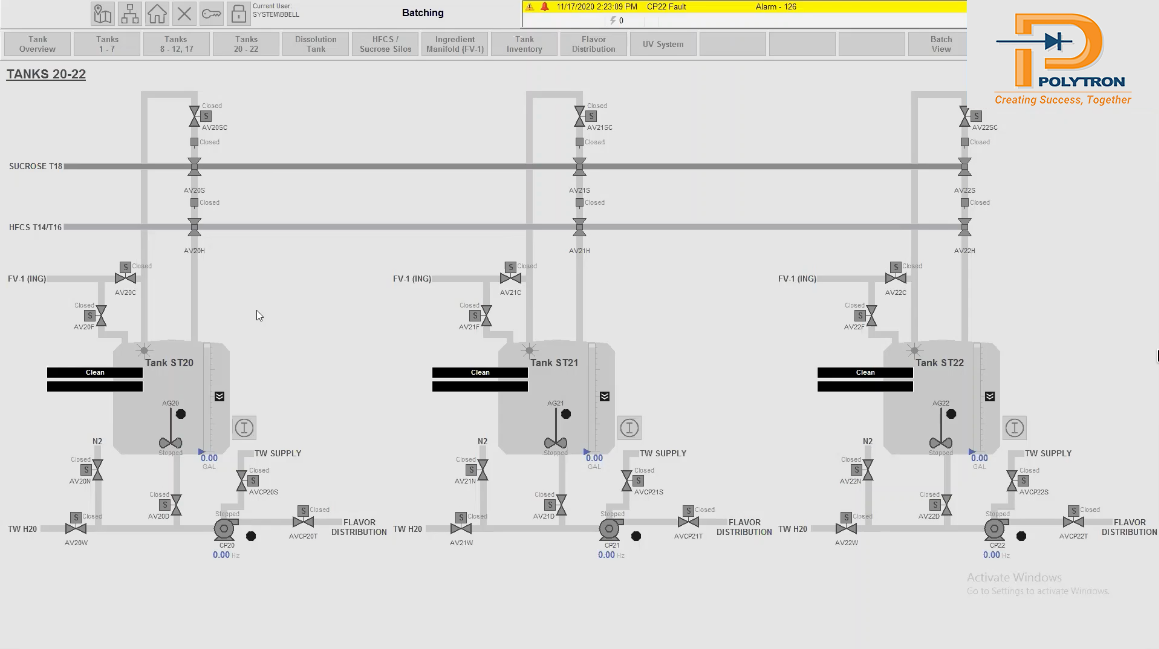
*An example of a batching process emulation.*
## Training with Emulation
PolySimsm serves as an effective tool for training staff to run and maintain the working system because it looks and responds like the actual production line. This is especially helpful because not all employees who interact with the line have time to experience changes prior to implementation of a project.
Consider a beverage manufacturing operation using emulation on a new packaging line. The trainer can use the HMI to communicate the critical importance of bottle population, for example, by demonstrating the impact of too few or too many bottles on overall line operation and the system.
### PolySimsm Eliminates the “Fear Factor” for Employees
Operators and technology leads can learn to make changes to PLC code or troubleshoot the system without the anxiety of making an expensive mistake. Examining scenarios in this way doesn’t create waste or impact production, but it delivers meaningful lessons that stay with the trainee long after typical classroom instruction.
## Unleash the Power of Emulation
In manufacturing, the key to success is to manage risk and eliminate the unknown to the highest degree possible. Emulation is a strategic tool that lets you troubleshoot and perfect engineering solutions in a safe digital environment.
For more than 20 years, Polytron has successfully used simulation and emulation technologies to help a diverse set of manufacturers expand and make major changes and decisions without the stress and risk that comes with guesswork or testing changes on a live production line.
## Ten Major Benefits of Emulation
1. Lowers overall investment risks
2. Reduces onsite testing time and costs for shorter startup time
3. Removes logic controls testing from the project’s critical path
4. Allows controls testing earlier in the project cycle
5. Tests multiple scenarios without wasting materials
6. Increases control system quality
7. Improves working conditions for controls engineers through safer testing
8. Improves operator training and minimizes disruption to existing production
9. Makes overall project duration simpler to forecast and budget
10. Allows 95 percent debugging and verification before installation
[Learn more about the differences between emulation and simulation.](https://polytron.com/resourcesinsights/webinar-simulation-emulation/)
[](https://info.polytron.com/blog/author/andrew-lawrence)
#### Andrew Lawrence
Andrew Lawrence is a project engineer at Polytron that works on electrical, automation, and engineering solutions within the manufacturing, packaging, and process industries. He focuses on emulation, simulation, control systems design, and PLC/HMI programming utilized in system and machine control. Andrew holds both a bachelor's and master’s degree in mechanical engineering from Georgia Institute of Technology.
Author
## Recommended For You
[](https://info.polytron.com/blog/why-having-a-unified-mechanical-and-controls-team-is-the-secret-to-faster-smarter-project-delivery)
[Automation and Controls](https://info.polytron.com/blog/tag/automation-and-controls)
2 Min Read
### [Why Having a Unified Mechanical and Controls Team is the Secret to Faster, Smarter Project Delivery](https://info.polytron.com/blog/why-having-a-unified-mechanical-and-controls-team-is-the-secret-to-faster-smarter-project-delivery)
[.png) Todd Walter August 20, 2025](https://info.polytron.com/blog/author/todd-walter)
[.png)](https://info.polytron.com/blog/ensure-project-success-with-proactive-start-up-planning)
[Process](https://info.polytron.com/blog/tag/process)
1 Min Read
### [Ensure Project Success with Proactive Start-Up Planning](https://info.polytron.com/blog/ensure-project-success-with-proactive-start-up-planning)
[ Damian Stahl, P.E., PMP January 28, 2025](https://info.polytron.com/blog/author/damian-stahl)
[](https://info.polytron.com/blog/why-skipping-front-end-engineering-is-the-most-expensive-mistake-in-capital-projects)
[Front-End Engineering](https://info.polytron.com/blog/tag/front-end-engineering)
3 Min Read
### [Why Skipping Front-End Engineering Is the Most Expensive Mistake in Capital Projects](https://info.polytron.com/blog/why-skipping-front-end-engineering-is-the-most-expensive-mistake-in-capital-projects)
[ David Hettesheimer, PE, PMP May 21, 2026](https://info.polytron.com/blog/author/david-hettesheimer-pe-pmp)
3097 Satellite Boulevard | Building 700, Suite 200 | Duluth, GA 30096
Phone: (855) 794-7659
[Terms](https://polytron.com/terms-of-use/) | [Privacy ](https://polytron.com/privacy-policy/)| [Sitemap](https://polytron.com/sitemap/)
```json
{
"@context" : "https://schema.org",
"@type" : "BlogPosting",
"author" : {
"@type" : "Person",
"name" : "Andrew Lawrence",
"url" : "https://info.polytron.com/blog/author/andrew-lawrence"
},
"dateModified" : "2026-03-11T15:29:37.291Z",
"datePublished" : "2026-03-11T12:00:01.000Z",
"headline" : "Emulation: Reduce Project Risk and Increase Certainty in Outcome",
"image" : [ "https://info.polytron.com/hubfs/Blog/Feature%20Images/Emulation%20Blog.png" ],
"mainEntityOfPage" : {
"@id" : "https://info.polytron.com/blog/emulation-reduce-project-risk-and-increase-certainty-in-outcome",
"@type" : "WebPage"
},
"publisher" : {
"@type" : "Organization",
"logo" : {
"@type" : "ImageObject",
"url" : "https://info.polytron.com/hubfs/Polytron%20Tagline%20Logo.svg"
}
}
}
```